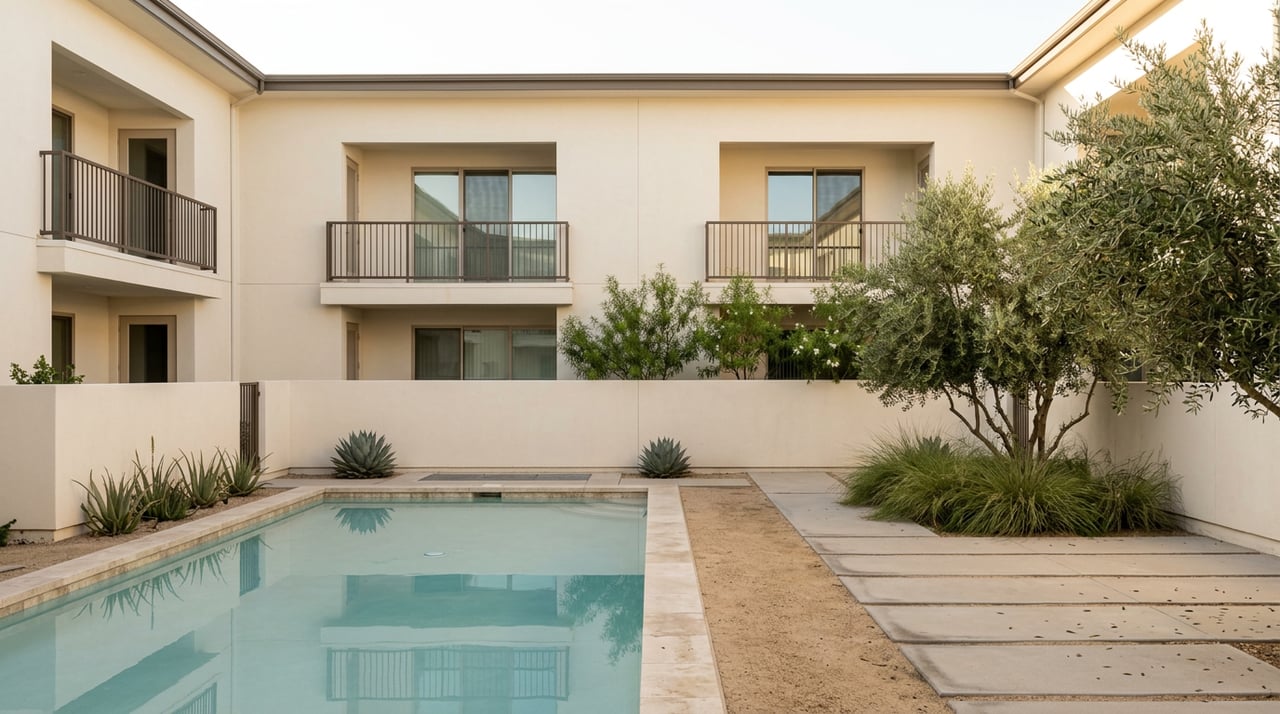
Scottsdale STR Investment Property? Check HOA Rules First
August 27, 2026
August 27, 2026
An investor closes on a house in McCormick Ranch, pulls the Scottsdale short-term rental license application, pays the $250 fee, lines up $500,000 in liability coverage, and lists the property before the ink on the closing documents has fully dried. Three weeks later, a letter arrives. Not from the city. From the HOA. The community's CC&Rs prohibit rentals under thirty days, and the city license the investor spent weeks obtaining does not override a private covenant. The property is now a long-term rental or a very expensive mistake, and the city had nothing to do with either outcome.
That gap between what Arizona law allows and what a homeowners association permits is the single most common way Scottsdale investment purchases go sideways, and it is almost never the first thing buyers check.
Arizona has spent a decade building one of the more host-friendly legal frameworks in the country, and that reputation is not wrong. Senate Bill 1350, passed in 2016, prevents cities and counties from banning short-term rentals outright or restricting them purely because of their use. That single law is why an investor can buy almost anywhere in the state with reasonable confidence that a city council can't zone their business model out of existence overnight.
Senate Bill 1168, passed in 2022, gave that same authority back to cities in a narrower form. Municipalities can now require licensing, cap occupancy, mandate insurance, and enforce nuisance rules. They still can't ban the activity. Scottsdale took that narrower authority and used essentially all of it.
Scottsdale's licensing structure runs through Ordinance 4566, and it is detailed enough that treating it as a formality is how people end up with fines. Here's what a compliant property actually carries:
| Requirement | Detail |
|---|---|
| City license | $250 per property, per year, renewed annually through the city's licensing portal |
| Liability insurance | $500,000 minimum, either a standalone policy or platform coverage |
| Occupancy cap | 6 adults plus dependent children, regardless of home size |
| Neighbor notification | All adjacent properties, plus homes directly and diagonally across the street, notified within 30 days of licensing |
| Combined tax burden | Roughly 14.27% across state Transaction Privilege Tax, county tax, and the city's transient lodging tax |
| Unlicensed penalty | $1,000 for every 30-day period the property operates without a required license |
Every dwelling unit and any accessory guest house on the parcel has to rent together as a single booking. There's no renting the casita separately from the main house, and no renting individual rooms. Anyone under 18 has been barred from booking a Scottsdale short-term rental since a May 2024 ordinance change. None of this is unusual by the standards of a regulated tourism market. What makes it worth walking through is that every single requirement on that list is one the city can enforce, and not one of them is the thing that actually shuts most properties down.
Scottsdale's enforcement wasn't static even before this. In May 2026 alone, the city issued 56 charges and citations tied to short-term rentals and police responded to 48 nuisance-related calls covering loud parties, criminal investigations, assaults, and welfare checks. That volume, arriving right before one of the busiest rental weekends of the year, is what pushed the city council to act.
On July 2, 2026, the council unanimously approved a new ordinance that gives police meaningfully more authority to shut down problem properties, with consequences that now hit both the party attendees and the property owner. Mayor Lisa Borowsky was direct about why the timing mattered, telling a local news crew the city had reached a breaking point:
"We're just really tired of it."
Borowsky also put a number on the scope of the problem, saying roughly 10% of short-term rental owners in Scottsdale account for the bad-actor cases driving the complaints. The old system let a property run a party, have police respond to a noise complaint, quiet down until officers left, then start back up again with no real consequence. The new ordinance closes that loop by formally defining an "event center." If a gathering is advertised on social media or tickets are sold for entry, the city can classify that home as an event center and act on it even if the party has already gone quiet by the time police arrive. The property owner faces the real exposure here, up to and including losing the license entirely and the ability to operate the home as a short-term rental at all.
For an investor evaluating a purchase, the practical read is simple. Scottsdale isn't tightening rules on paper and looking the other way in practice. It's actively building the enforcement infrastructure to make the existing rules bite harder, and a license that's easy to obtain today is not a guarantee that operating loosely stays consequence-free.
None of that enforcement reaches the one restriction that ends up mattering most in Scottsdale's most desirable submarkets: the HOA.
State preemption under SB 1350 and SB 1168 applies to governments. It does not apply to private covenants. A homeowners association can prohibit short-term rentals entirely, or require minimum lease terms of thirty days or longer, through its recorded CC&Rs, and that restriction sits completely outside the city's jurisdiction. An investor can be fully licensed under Ordinance 4566, fully insured, fully compliant with every city requirement, and still be legally blocked from hosting a single guest because the community's governing documents say no.
This isn't a hypothetical edge case in Scottsdale. Certain buildings and communities within Old Town Scottsdale, particularly some of the newer condominium developments, restrict or prohibit short-term rentals through their own association rules. So do some communities within Gainey Ranch and McCormick Ranch, two of the addresses investors most often target for their proximity to golf, resorts, and walkable dining. The city allows short-term rentals by right in every residential zone. The HOA doesn't have to agree, and in a growing number of these communities, it doesn't.
More HOAs are amending their CC&Rs specifically to add these restrictions as short-term rental activity has grown, which means a community that allowed STRs when a previous owner bought in five years ago may not allow them today. Buying with an STR strategy in mind means checking the governing documents as they stand right now, not relying on what a listing agent, a neighbor, or an old forum post says the rules used to be.
The instinct for most buyers is to research city rules first, since that's what shows up in every search result and every general guide to Arizona short-term rentals. In Scottsdale specifically, that order gets the buyer nothing useful. The city's rules apply the same way to every residential property in every neighborhood. What varies, property by property, is the HOA.
The sequence that actually protects an investment thesis runs the other way:
A property that clears the HOA check and the city check is genuinely well positioned. Scottsdale's registration requirements filter out casual operators, and the demand base for short-term stays here, driven by golf, spas, and a long winter season, has stayed strong even as the compliance bar has risen. That combination rewards owners who do the paperwork and shuts out the ones who don't. The investors who get burned in this market are almost never the ones who read the ordinance too closely. They're the ones who never read the CC&Rs at all.
Can an HOA ban short-term rentals even though the city allows them? Yes. State preemption law prevents cities and counties from banning STRs outright, but that protection applies to government action, not to private community covenants. An HOA can prohibit short-term rentals or require longer minimum lease terms through its CC&Rs, and that restriction stands regardless of what the city permits.
If I already own a Scottsdale rental and the HOA changes its rules, am I grandfathered in? This depends entirely on the specific language in the amendment and the association's governing documents, and it's a question worth taking to an attorney rather than assuming either way. What's clear across Scottsdale generally is that more associations are amending their CC&Rs to add or tighten STR restrictions, so an owner who was compliant at purchase should not assume that stays true indefinitely.
Does the city's July 2026 crackdown change licensing requirements, or just enforcement? Enforcement. The new ordinance gives police more authority to act on party-house situations and formally defines when a property counts as an "event center," but the underlying licensing structure under Ordinance 4566, the fees, and the insurance minimums haven't changed. What's changed is how aggressively the city can act once a property crosses the line.
Buying an investment property in Scottsdale rewards the buyer who checks the boring documents before the exciting ones. If you're evaluating a specific address for its short-term rental potential, or trying to figure out whether a property that looks perfect on paper actually clears its own HOA, The Ackerman Team can walk the numbers and the governing documents with you before you write an offer, not after.
September 17, 2026
September 10, 2026
September 3, 2026
Blog
August 28, 2026
August 27, 2026
August 20, 2026
August 13, 2026
August 6, 2026
August 6, 2026
The Ackerman Team is dedicated to providing you with exceptional service and unparalleled expertise. Reach out to us today.